
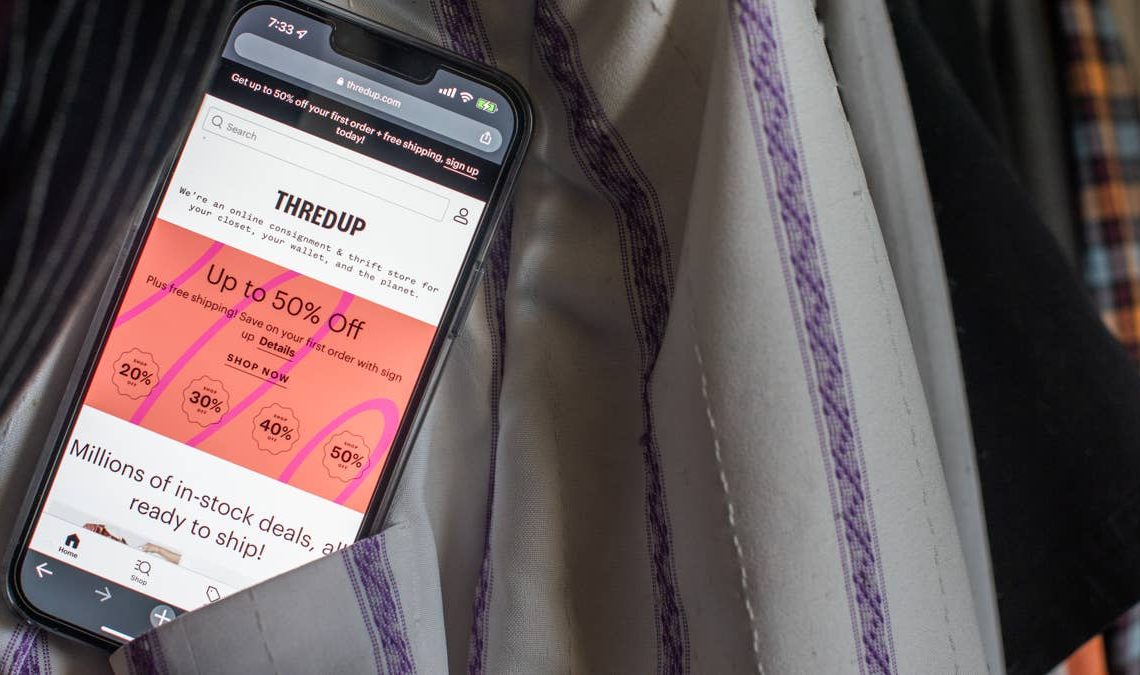
Over the last few years, there’s been a substantial increase in the number of consumers shopping for secondhand apparel.
Where used clothing was once viewed as a badge of inferiority, it’s now become a mainstream consumer preference.
In fact, ThredUp’s 2026 Resale Report predicts that the secondhand market will grow twice as fast as the traditional fashion market over the next five years.
In an effort to capture as much of that market share as possible, ThredUp has launched an all-new feature, aimed directly at poaching loyal customers of one of its largest competitors, eBay.
The resale dilemma: peer-to-peer vs. managed marketplaces
Historically, there have been two kinds of digital resale platforms: peer-to-peer and managed marketplaces.
Of the peer-to-peer platforms, eBay is arguably the best-known. On eBay, users list, sell, package, and mail all of their own inventory, be that last season’s jeans or true-vintage party dresses.
Some secondhand sellers prefer this option as it allows them to keep more of the profits (eBay does take a small portion of the sale), while others begrudge the effort required to rid themselves of unwanted items.
For those sellers, managed platforms like ThredUp are usually the preferred option. At ThredUp, sellers package up all of their unwanted clothing and mail it off to the company, who then sorts through the castoffs, prices and lists them, and ships them off to their new homes.
With the introduction of its latest feature, a peer-to-peer marketplace, ThredUp has officially combined the two types of reselling platforms, establishing itself as the leading hybrid option for buyers and sellers.
ThredUp launches direct listings
ThredUp’s new feature, Direct Listings, is an open-beta, peer-to-peer marketplace that allows sellers to hand-list items.
For the first time in the platform’s history, it allows sellers to have complete control over the pricing of certain pieces.
In early tests, items listed through the Direct Listings feature of the platform sold for $60, according to ThredUp data shared with Fast Company. That number is more than double the average price of items sold through the company’s managed marketplace.
Sellers who use the feature don’t pay a fee — a perk that other resell platforms who typically charge between 10-12% don’t offer.
Perhaps most crucially, the new feature is aimed at serving casual resellers and buyers, not career listers.
The goal was “a lean-back type of product experience,” ThredUp CEO James Reinhart told Fast Company.
“The casual seller who doesn’t want to spend every day managing their listings and responding to comments and price-optimizing gets crowded out of those [professional-oriented] marketplaces,” he continued.
Getty Images
ThredUp wants to be a one-stop shop for resale
ThredUp’s new feature comes at a crucial moment for the resale industry.
Secondhand shopping is experiencing massive growth – the U.S. market alone is expected to hit $78.7 billion by 2030, according to GlobalData Managing Director Neil Saunders — which means the market is getting increasingly crowded.
But Reinhart has an eye toward the future, and isn’t certain that the boom will hold for long.
“What you’ll see over the next couple of years is consolidation,” he told Fast Company.
In order to ensure it survives that consolidation, ThredUp is expanding beyond the managed-resale model that built its business and looking for ways to serve a broader range of buyers and sellers.
More retail:
- Walmart launches exclusive premium beef line
- Dave Ramsey warns shoppers to avoid Costco trap
- 131-year-old coffee giant is coming for Keurig’s U.S. dominance
Historically, the company has focused on consumers who prefer a hands-off selling experience. Direct Listings opens the door to shoppers and sellers who want more control over pricing and inventory, allowing ThredUp to compete for a segment of the resale market that previously gravitated toward platforms like eBay.
“There are fundamentally pockets of sellers and pockets of the market that we were not addressing,” the CEO told investors during ThredUp’s first quarter fiscal year 2026 earnings call in May.
One type of these overlooked customers are the sellers who prefer to have more control over the reselling process.
Direct Listings, then, is the company’s latest attempt to solve that problem and serve those overlooked buyers and sellers.
“People are going to be looking for a one-stop shop, because people are generally lazy,” he told Fast Company. “We want to be that one super app for selling.”
Related: Dollar General CEO exposes bitter reality about today’s economy